Superpower and Rythm Health get compared because both sell blood testing without a doctor's order, but they are built around opposite ideas. Superpower sends you to a lab once or twice a year for a broad panel of 100+ biomarkers, for a flat annual fee. Rythm Health, often searched as Rhythm Health, mails a kit to your door every month and tests a short list of 25+ markers from a sample you collect yourself, at $79 a test before shipping.
So this is not really a contest between two versions of the same product. It is breadth against frequency, a lab chair against your kitchen table, and a flat annual fee against a bill that grows every time you test. This comparison works out what each one costs across a full year, what each one actually measures, and which kind of person should buy which.
Superpower vs Rythm vs OneTwenty: Comparison Chart
| Compared on |  Superpower |  Rythm Health |  OneTwenty |
|---|---|---|---|
| Price | $199 to $349 a year, depending on the offer | $79 a test, plus shipping and tax | $499 a year |
| Price in NY & NJ | May vary, check at checkout | Same price, shorter men's panel in New York | $749 a year |
| Cost of a full year | $199 to $349 | About $1,200 monthly, or $400 quarterly | $499 |
| Tests included | 1 or 2 lab draws a year, depending on the offer | 1 a month, or skip up to 90 days | 4 a year: 1 full, 3 targeted |
| Biomarkers | 100+ to 150+ a year, depending on the offer | 25+ per test, same panel each time | 101 at baseline, then 20 to 40 per follow-up |
| How blood is collected | At a Quest lab, or at home for a fee | At home, with an upper-arm device | At a lab, or at home for $99 a draw |
| Results turnaround | About a week | About 48 hours after processing | About a week |
| Who reads the results | An AI assistant, with a clinician care team | A physician signs off, plus an AI Coach | A health coach on every panel |
| Wearable data | Oura, Whoop, Apple Health | None | 22 device metrics, tracked daily |
| Supplements | Sold in its marketplace | None | Lab-matched packs, from $45 a month |
| Prescriptions | Yes, billed separately | None | Yes, through licensed providers, billed separately |
| Add-on tests | Gut, toxins, cancer screening | None yet | Extra panels or single markers |
| Commitment | Annual, cancel anytime | Monthly, skip or cancel anytime | Annual |
| HSA / FSA | Eligible | Eligible | Eligible |
| Best for | A first broad panel at a low flat price | Tracking a few markers every month | A full baseline plus retesting |
| Our rating | 4 / 5 | 4 / 5 | 5 / 5 |
OneTwenty is the alternative we recommend further down. Crown Counseling has a business relationship with OneTwenty, so weigh our rating of it with that in mind.
The Three Dashboards, Side by Side
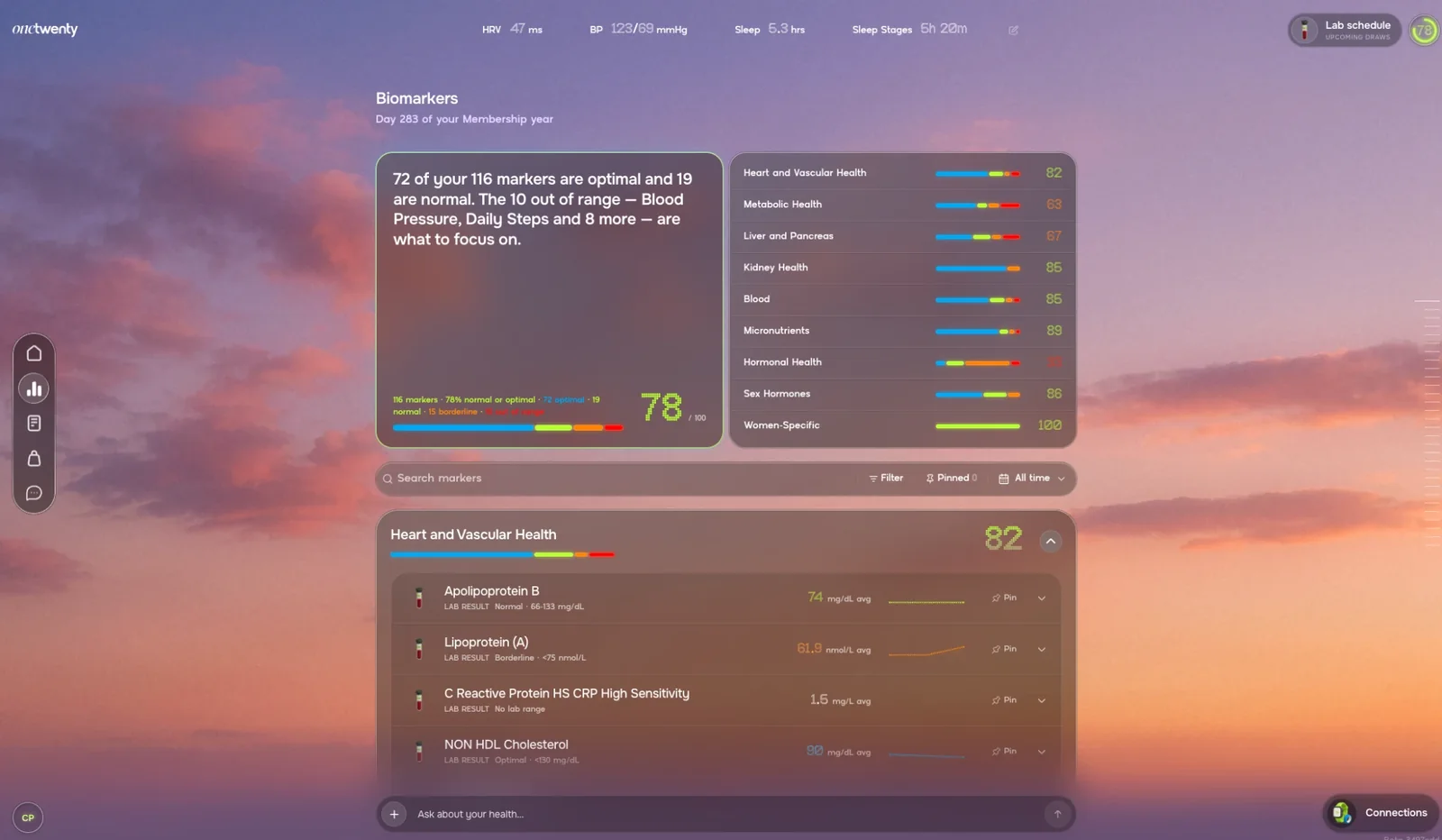
All three turn a lab report into a screen you can read. What each one puts first tells you what it thinks its job is.
Superpower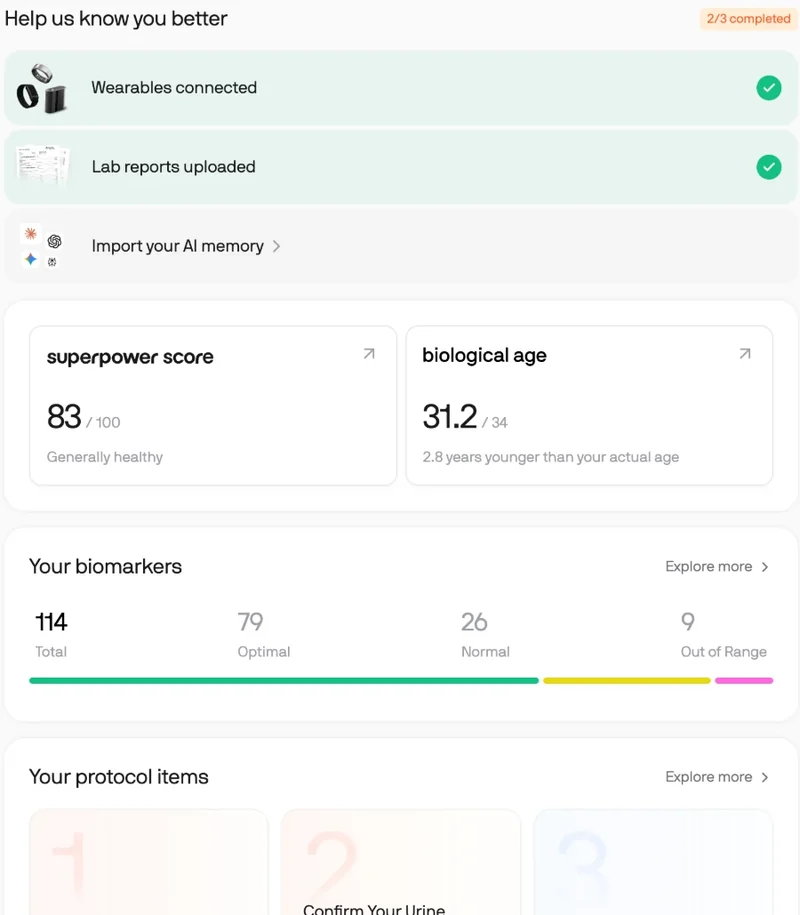 Rythm Health
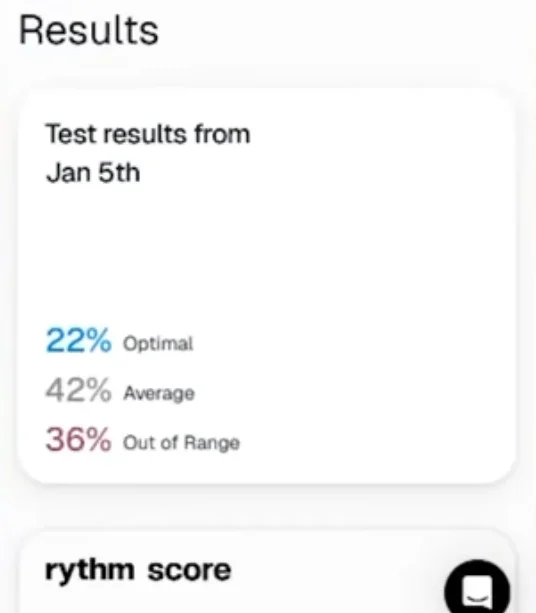 OneTwenty
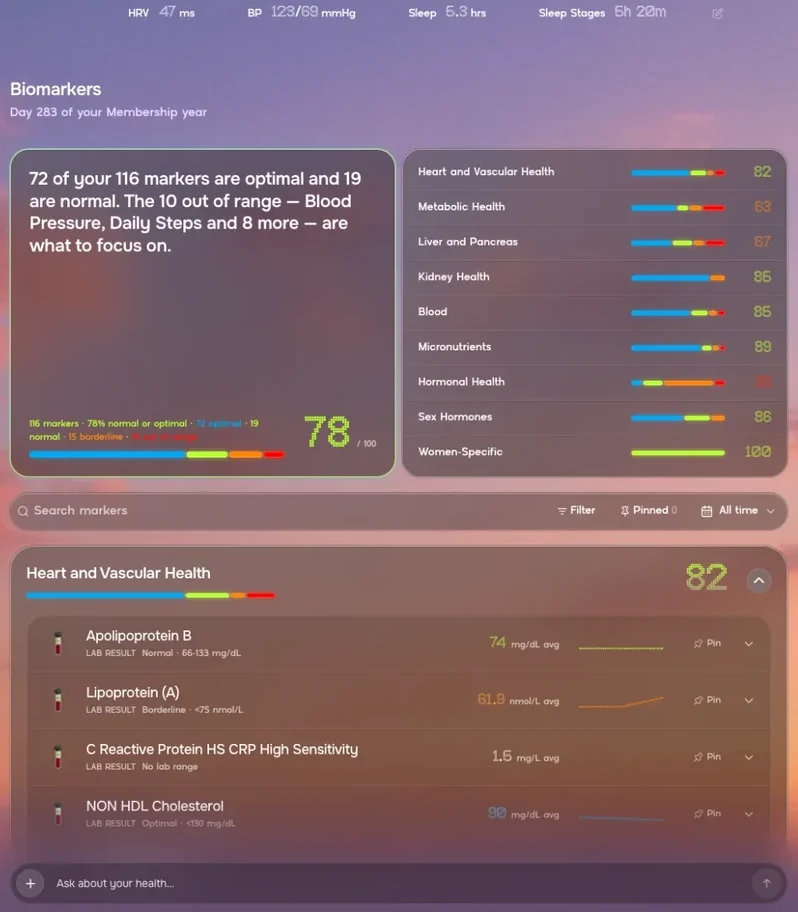
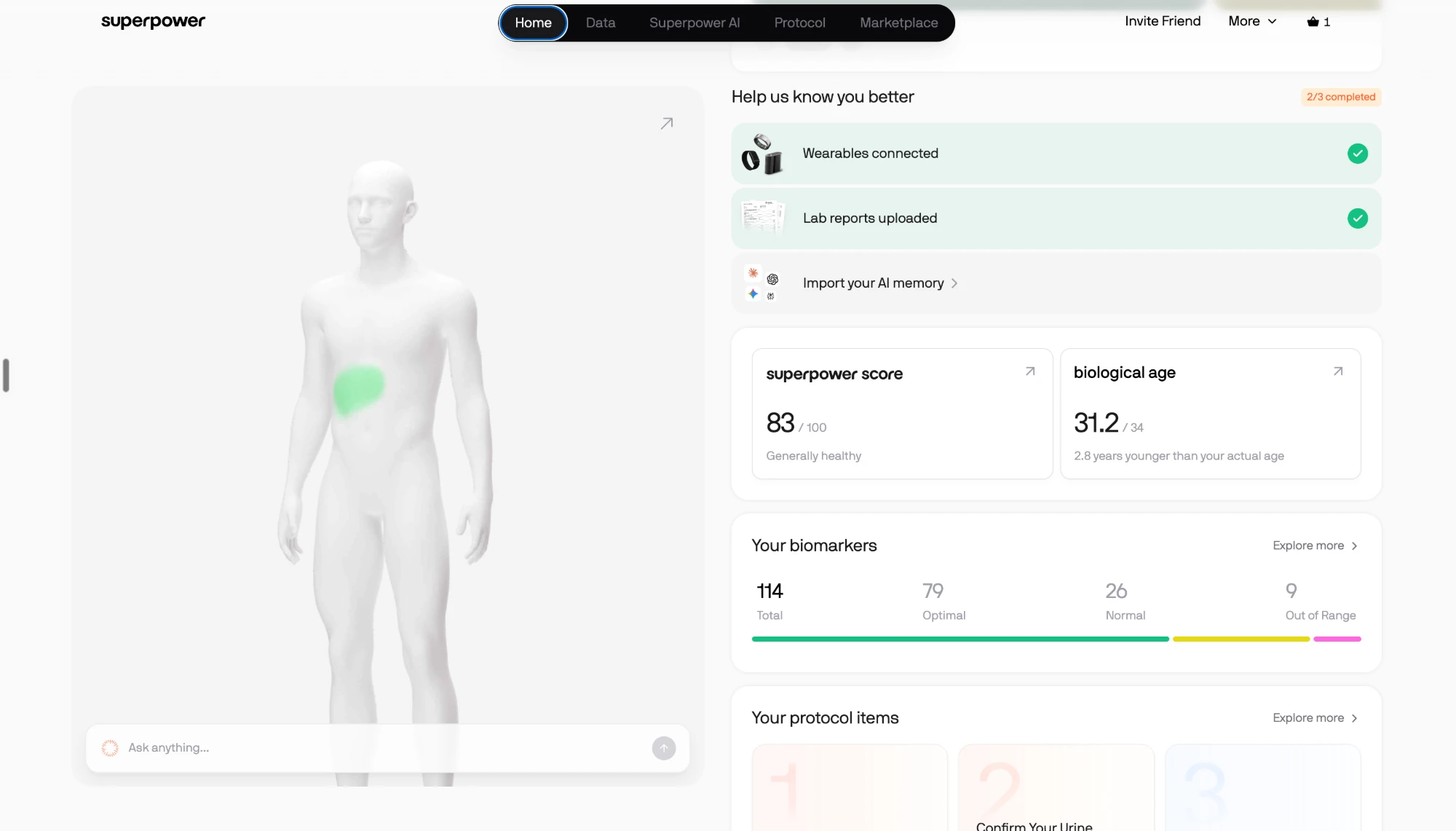
Superpower and OneTwenty are shown on desktop and Rythm on a phone, each cropped to the same shape. Rythm screenshot courtesy of Cj's Rythm Health follow-up review on YouTube. Logos and screenshots belong to their respective companies.
The Quick Verdict
Pick Superpower if you have never had a comprehensive panel. A flat annual fee buys a lab draw of 100+ biomarkers, which works out at about $2 a marker and is among the cheapest broad baselines in this category. You also get an app that reads your wearable, an AI assistant, a care team and, depending on the offer, a second draw or a follow-up test a few months later.
Pick Rythm if you already know what you are watching. If the question is whether your testosterone, ApoB or ferritin is moving month to month, Rythm answers it better than anything else here. You never visit a lab, results land within days, and you can skip up to 90 days at a time. You pay for that: about $100 a test once shipping is added, for a quarter of the markers.
They are not substitutes. Superpower tells you where you stand across your whole body and then mostly goes quiet until the next draw. Rythm tells you how a short list is trending and never looks at the rest. Buying the wrong one for your question is the expensive mistake, and it is an easy one to make because the two are marketed in the same breath.
If you want both things, a full baseline and regular retesting, the honest options are to buy both, to pay Superpower for extra tests, or to use a service that includes the retests. We cover that third route in the alternative section.
What a Year of Each Actually Costs
The two prices are not built the same way, which is why the headline numbers mislead. Superpower charges once a year. Rythm charges every time a kit ships. Put them on the same footing and the picture changes depending on how often you test.
| How you use it | Tests a year | Markers per test | Cost of the year | Cost per marker tested |
|---|---|---|---|---|
| Superpower, as sold | 1 or 2, depending on the offer | 100+ on the full draw | $199 to $349 | About $2 |
| Rythm, every month | 12 | 25+ | $948 at list, about $1,200 delivered | About $3 to $4 |
| Rythm, every quarter | 4 | 25+ | $316 at list, about $400 delivered | About $3 to $4 |
| OneTwenty | 4 (1 full, 3 targeted) | 101, then 20 to 40 | $499 | Not like for like |
Rythm's $79 is not what you pay. Its own site lists the price as $79 a test plus shipping and tax, with 30% off the first test. Independent reviewers and members report regular orders landing around $100 once the kit and two-way shipping are added, which is the figure we use in our full Rythm Health review. Twelve of those is about $1,200 a year.
Rythm used quarterly costs as much as Superpower or more, for a quarter of the markers each time. That sounds damning and is not quite fair. Four Rythm tests give you four readings of the markers you care about. Superpower's membership gives you one full reading and at most one follow-up, and anything more is an extra charge.
Per marker, Superpower wins by a wide margin. About $2 a marker against $3 to $4. A lab draw is simply a cheaper way to measure a lot of things at once, because nobody is paying for a single-use collection device and overnight medical shipping.
Check the price on the day you buy
Superpower changes its price and what the membership includes every couple of months. During 2026 it has been $199 a year with one draw and $349 a year with two. Nothing in this comparison depends on which offer is running: either way it is a broad lab panel for a flat annual fee. Its pricing page also says pricing may vary in New York and New Jersey without publishing a figure.
Rythm charges the same everywhere, but hematocrit and hemoglobin, which are on its men's panel, are not available in New York State. Men there get a slightly shorter panel for the same money.
Superpower, In Detail
Superpower launched in 2023 out of Los Angeles with one idea: make the kind of broad panel that concierge clinics charge thousands for cheap enough that price stops being the excuse. Whichever offer is running, it is one of the lowest-priced ways into comprehensive testing that we cover, and the app around the results is more capable than the price suggests. Our Superpower review goes deeper on the platform itself.
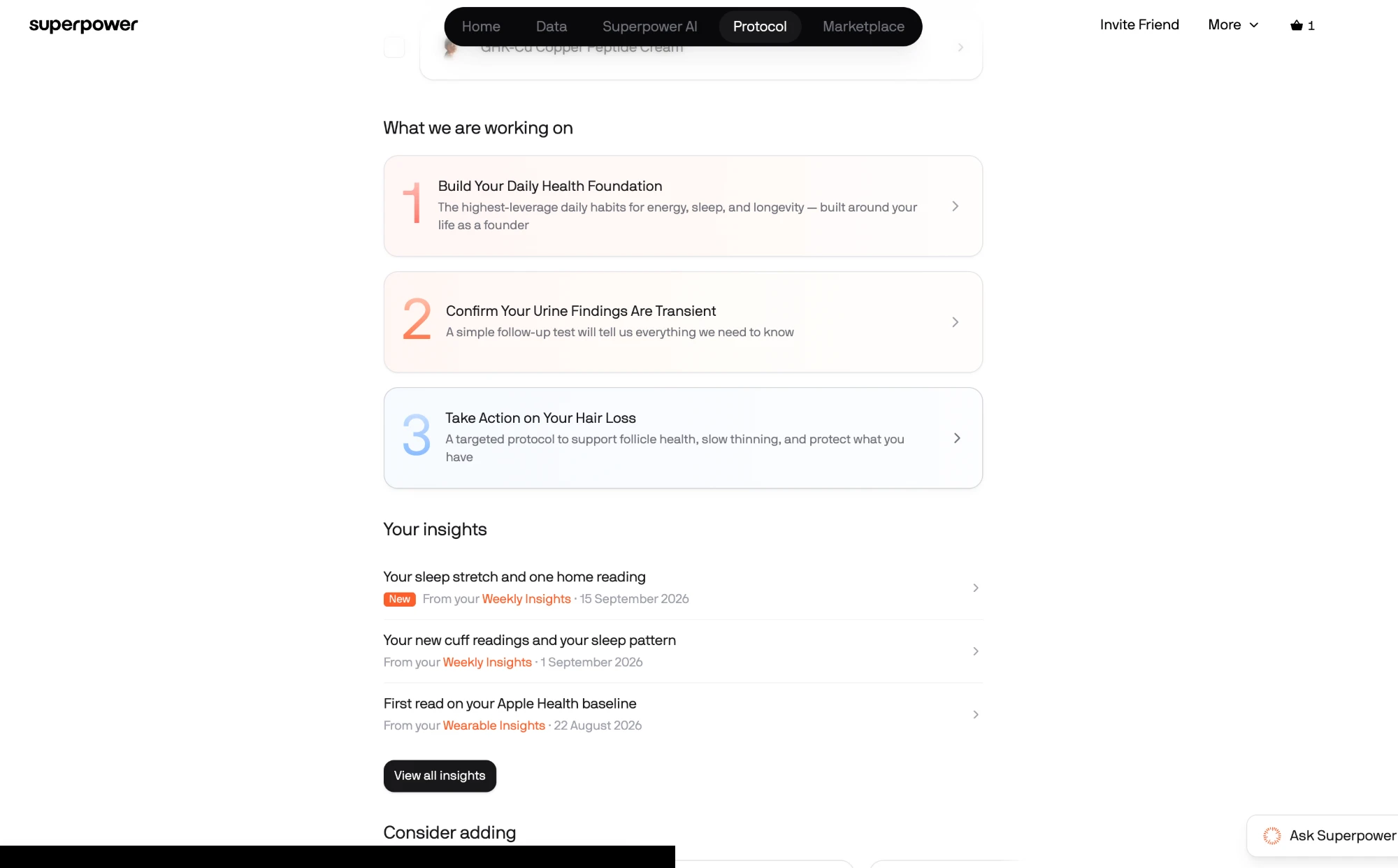
- 100+ biomarkers from a lab draw covering heart health, hormones, metabolic health, inflammation, nutrients, liver, kidney and thyroid.
- One or two draws a year are included, depending on the offer. On the one-draw offer, new members have been able to claim a complimentary follow-up test three to six months after the first draw. Further tests are an extra charge.
- Drawn at a lab. You book at one of 2,000+ Quest locations, or pay extra for a phlebotomist to come to you. Results are typically ready in about a week.
- A dashboard that interprets. A biological age, 17 health scores, and an action plan after each test.
- Superpower AI and a care team. An in-app assistant that answers from your own results, with clinicians behind it for anything it cannot settle.
- Wearables and old labs. It syncs Oura, Whoop and Apple Health and accepts uploads of past lab reports.
- A marketplace. Supplements, prescriptions, peptides and add-on tests for gut health, toxins and cancer screening, each billed on top of the membership.
Where Superpower wins
- Four times the markers in a single test
- About $2 a marker, the cheapest here
- A full venous draw by a phlebotomist
- Reads your wearable data
- Can act on results: supplements and prescriptions
- A care team you can message
Where Superpower falls short
- One or two draws a year, so little trend data
- You have to book and travel to a lab
- Results take about a week
- Recommends products it also sells
- No published price for New York and New Jersey
- Price and plan change every couple of months
The thing to watch on Superpower is the gap between the membership and the bill. The membership fee buys the testing and the platform. The supplements it recommends, the prescriptions it offers and the extra panels in its marketplace are separate charges, and the app is designed to lead you toward them. That is a legitimate business model. It is also a reason to treat a recommendation as a starting point and not as a verdict.
Rythm Health, In Detail
Rythm is built on the belief that one snapshot a year tells you very little, and that the useful information is in how a marker moves. So it tests a short panel, makes the test as easy as possible to repeat, and returns results fast enough that a change you made last month shows up this month.
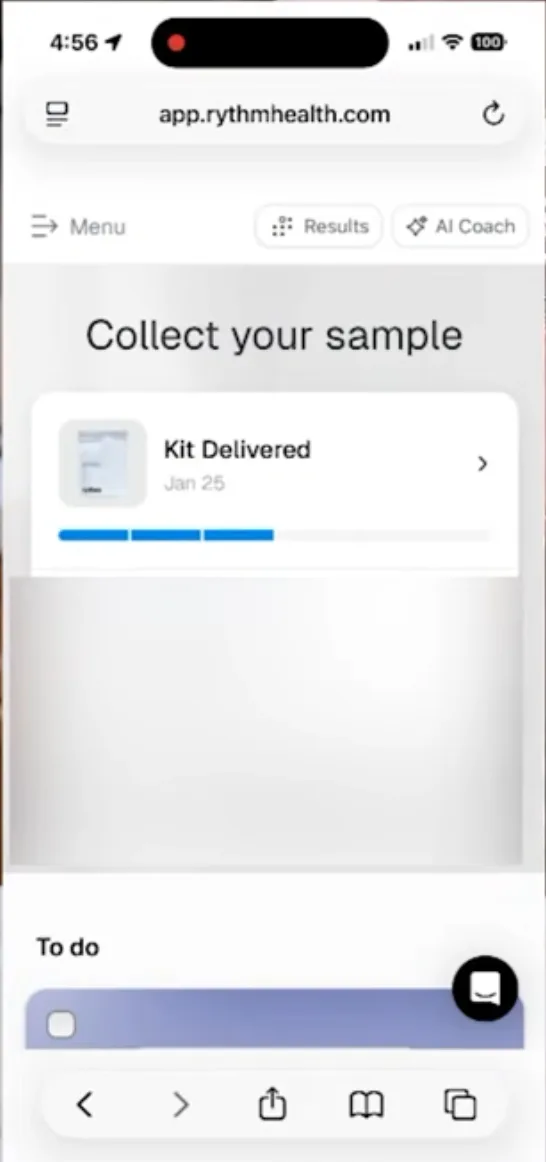
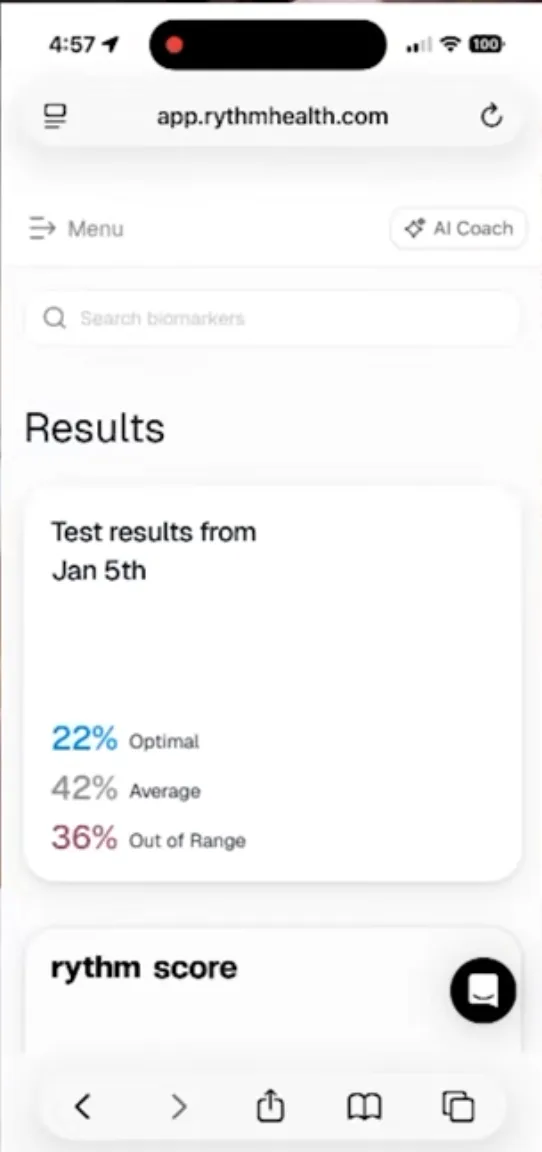
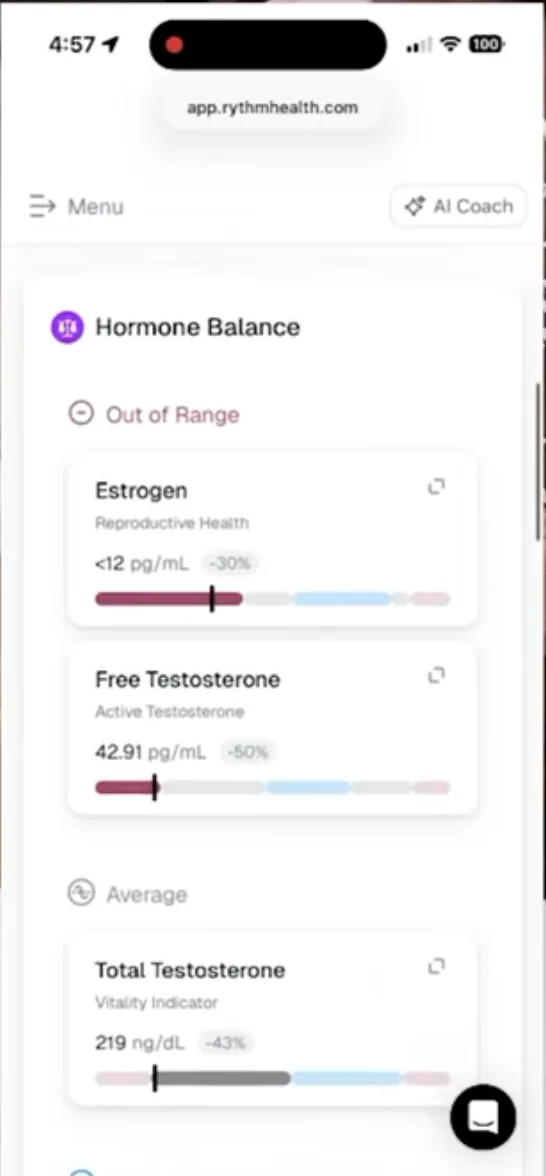
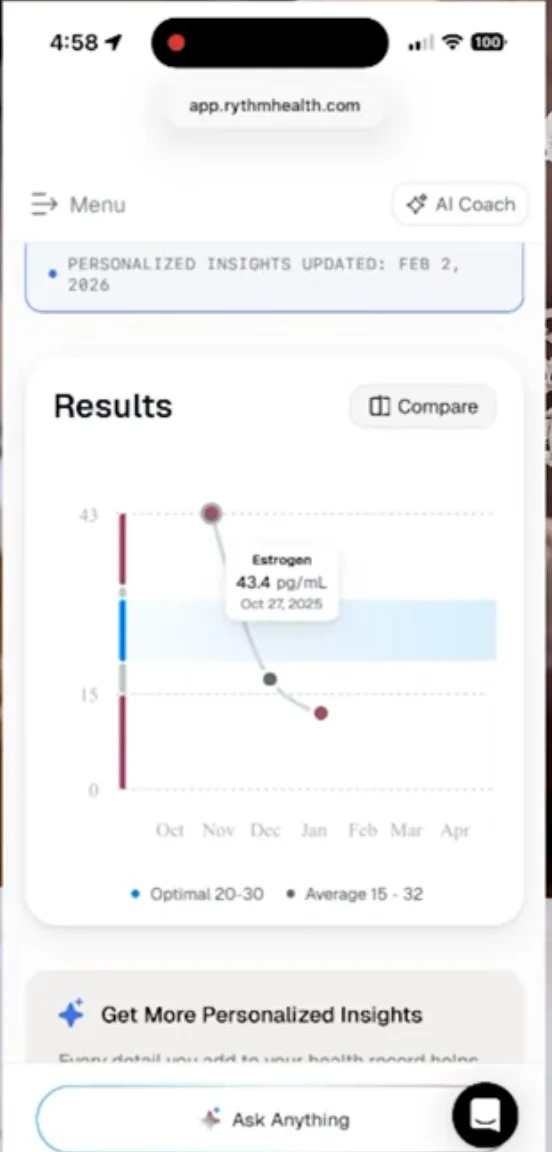
- 25+ biomarkers per test. Hormones (total and free testosterone, estradiol, SHBG, cortisol), thyroid, heart health including ApoB and hsCRP, metabolic markers such as vitamin D, ferritin and triglycerides, and kidney and liver essentials. The men's and women's panels differ, and some markers are for one sex only.
- Monthly by design. The subscription renews every 30 days. You can skip up to 90 days at a time without being charged, and cancel with no fee.
- Collected at home. You press a small device against your upper arm, it draws a capillary sample in a few minutes, and FedEx collects it. No lab visit and no needle in a vein.
- Its own lab. Rythm runs the samples itself, a state-licensed physician signs off each report, and results arrive within about 48 hours of processing.
- An app built around trends. A Rythm Score, a biological age, a chart for every marker, an AI Coach, and exports to PDF or CSV for your own doctor.
- Available in every state except Rhode Island, HSA and FSA eligible, with a 90-day money-back guarantee on a first purchase.
Where Rythm wins
- Monthly readings, so real trend lines
- No lab visit and no venous draw
- Results in days, not a week
- Skip months or cancel with no fee
- Available in every state
- Money-back guarantee on the first order
Where Rythm falls short
- About $100 a test once shipping is added
- About $1,200 a year tested monthly
- A quarter of the markers Superpower tests
- No add-on tests yet
- No supplements, prescriptions or wearable data
- A self-collected sample can come up short
Two things are worth knowing before you subscribe. The first is that the painless arm device is the Tasso+, made by a separate company and sold to many labs and telehealth services, so it is not a reason to choose Rythm over another at-home test. The second is that collecting your own sample has a failure mode a lab draw does not. Rythm's own help pages say a sample can be rejected for too little volume, and that some markers can be dropped from a report if the sample spends too long in transit. Post it the day you collect it, early in the week.
Where They Actually Differ
Strip away the dashboards and the biological age scores, which both have, and four real differences are left.
- Breadth against frequency. Superpower measures 100+ things once or twice a year. Rythm measures 25+ things as often as monthly. One finds problems you did not know to look for. The other tells you whether the thing you are working on is moving.
- A lab against your home. Superpower needs an appointment, a trip and a needle in your arm. Rythm needs ten minutes at your kitchen table before breakfast. If a lab visit is the reason you have never been tested, that difference matters more than any number in this article.
- What happens after the results. Superpower can sell you the supplement and connect you to a prescription. Rythm stops at the data: it does not diagnose, treat or prescribe, and it tells you to take concerns to your own doctor.
- How you are charged. Superpower is one annual payment and you are done. Rythm bills every 30 days unless you skip, so the cost of a year is something you decide a month at a time.
Who should pick which
Pick Superpower if this is your first comprehensive panel, you want the most markers for the least money, or you want the platform to do something with the results.
Pick Rythm if you are tracking specific markers closely, for example hormones on TRT, cholesterol after a diet change or ferritin during training, and you would rather pay more than visit a lab.
Use both if you want a broad baseline once a year and a short panel in between. Budget about $600 to $750 a year for Superpower plus quarterly Rythm, and expect two apps that do not talk to each other.
Pick neither if what you want is one service that takes the full baseline and then retests what matters through the year.
A Full Baseline and the Retests in One Price: OneTwenty
Disclosure: Crown Counseling has a business relationship with OneTwenty. Weigh this recommendation with that in mind, and check it against the chart above.
OneTwenty
Superpower gives you the wide view once. Rythm gives you a narrow view often. OneTwenty is built on doing both in order: a full baseline of 101 lab markers, then three follow-up panels of 20 to 40 markers across the year, chosen from what came back off or what you are trying to change. That is four draws for $499, with a health coach on every panel, 22 device metrics tracked daily in between, and prescriptions through independent licensed providers when one is appropriate, with medications billed separately. It is available in every state except Rhode Island, at $749 in New York and New Jersey.
It is not the cheapest of the three and it is not the most frequent. If one broad panel is all you want, Superpower costs less. If you want the same markers every single month from home, Rythm does that and OneTwenty does not.
The baseline Rythm skips
The first panel covers 101 markers, so you find out what needs watching before you start watching it.
More retests than Superpower includes
Three follow-up panels are in the membership, one about every 90 days. A change you make in January is measured in April.
Follow-ups chosen from your results
Each follow-up tests 20 to 40 markers picked from what was off, not the same fixed list every time.
Data between the draws
22 device metrics tracked daily sit beside your labs, so the plan can move before the next panel.
Inside the OneTwenty dashboard
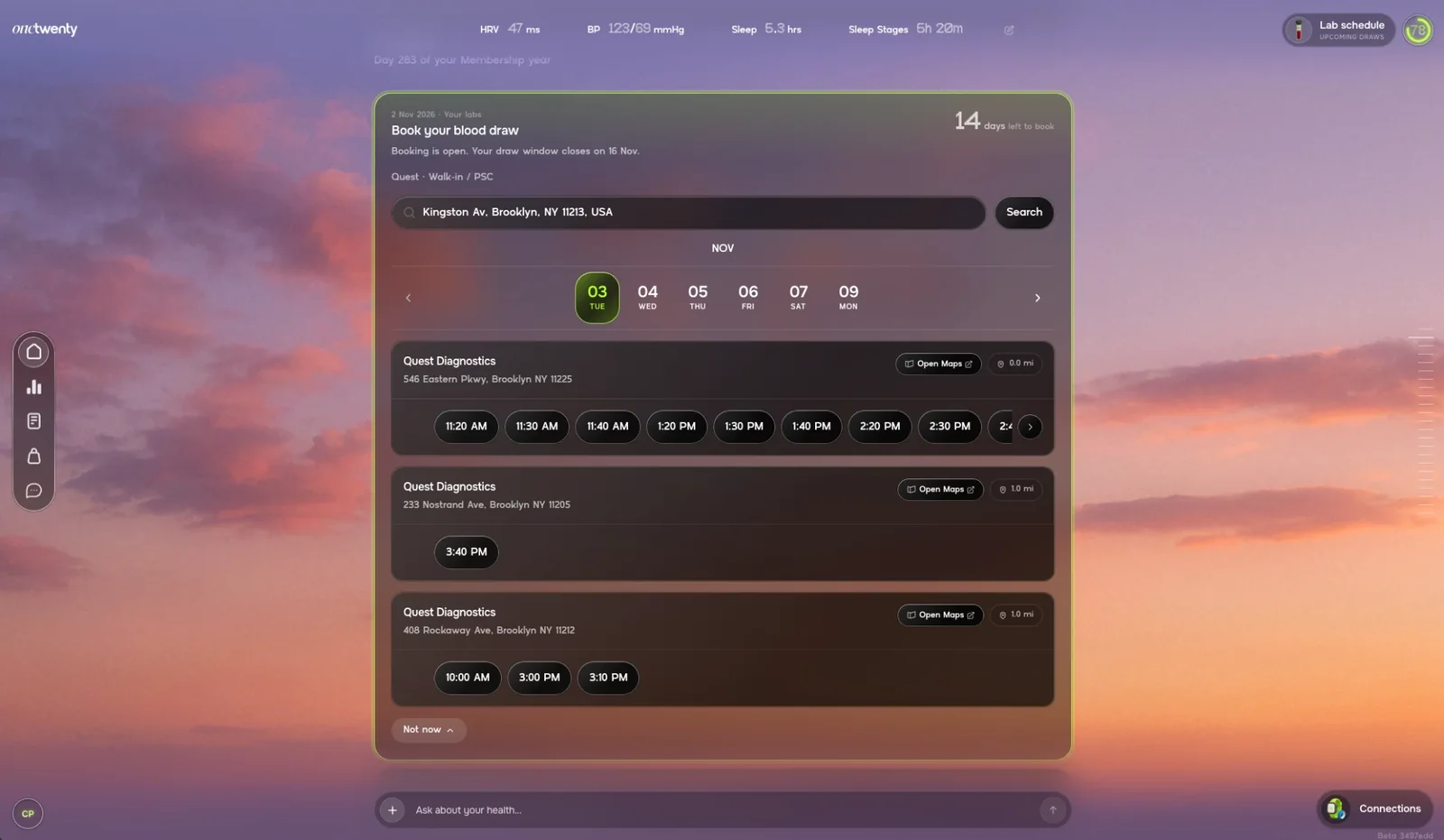
OneTwenty’s member dashboard puts your labs, your devices and your next step on one screen. Your latest device readings run along the top of every page (heart rate variability, blood pressure, sleep and sleep stages), beside your lab schedule and overall health score.
- Your markers in one read. The biomarkers page opens with a plain-English summary of how many results are optimal, which are out of range and which to focus on first, then scores each body system, from heart and vascular health to hormones and micronutrients.
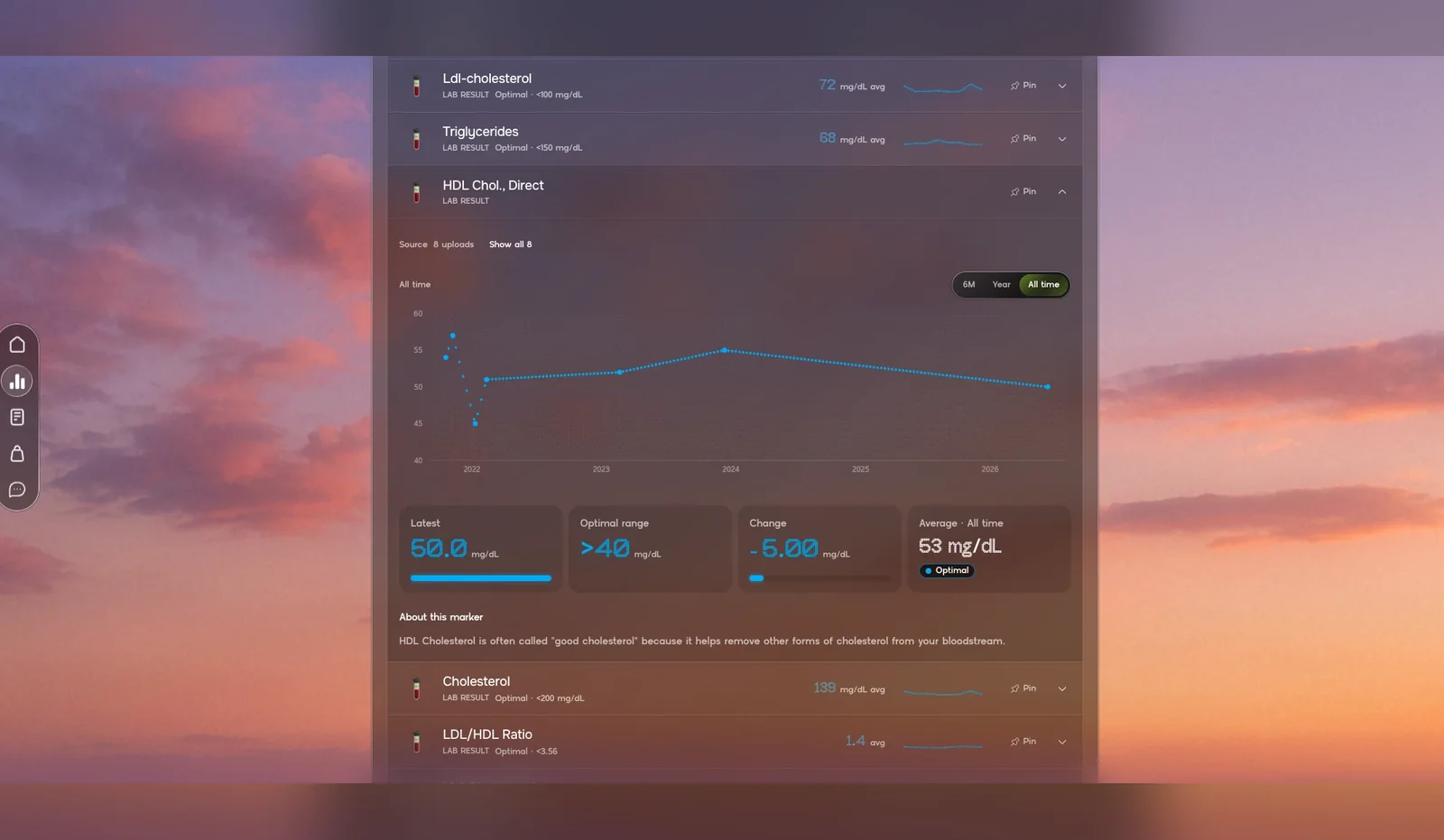
- Every result on one chart. Open any marker and its full history sits on a single timeline, older lab reports you upload included, with the optimal range, the change since your last draw and a short note on what the marker means.
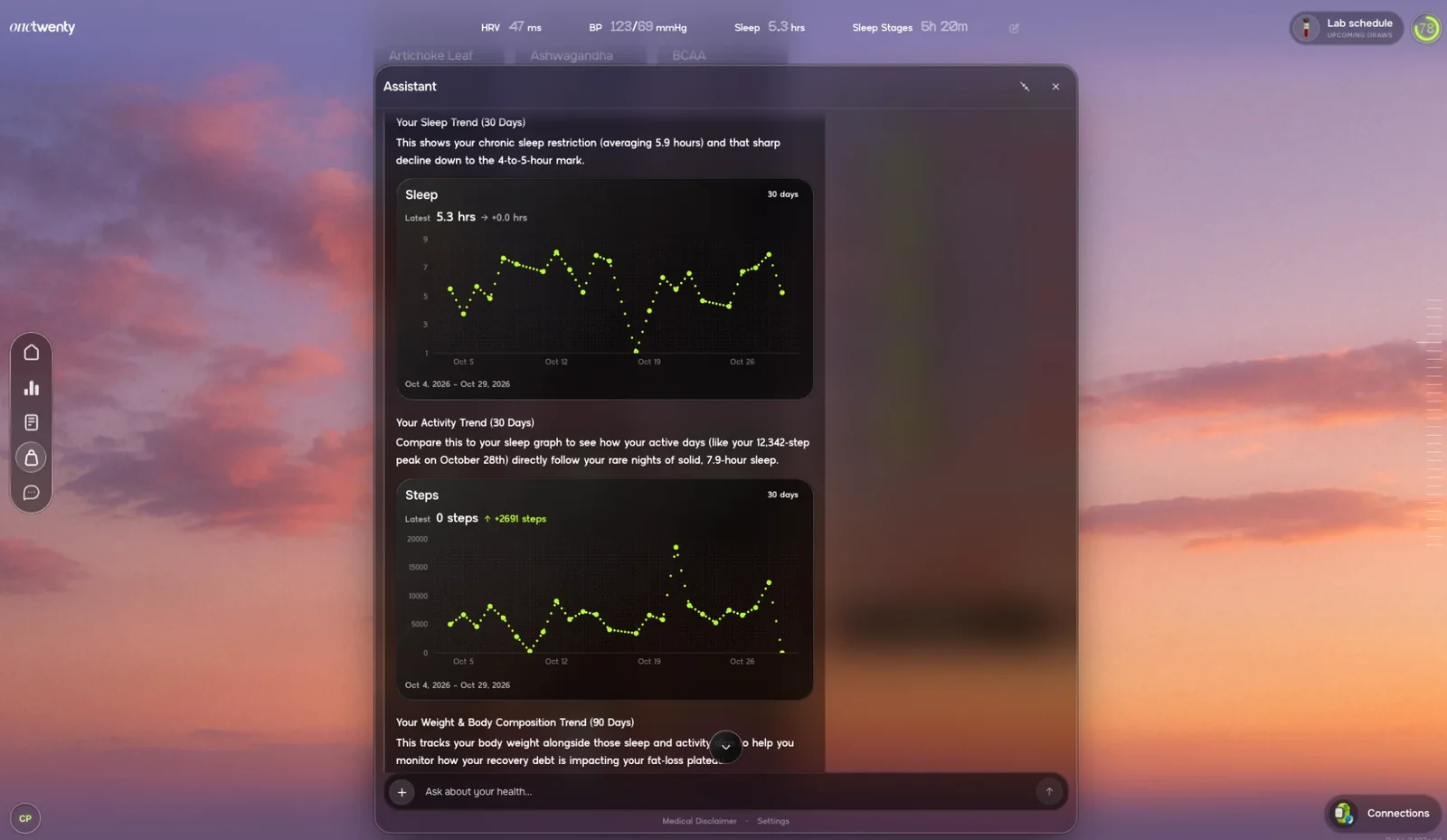
- An assistant that answers with your data. Ask a question from any page and it replies with your own charts, such as a month of sleep set against a month of steps, and explains how the two connect.
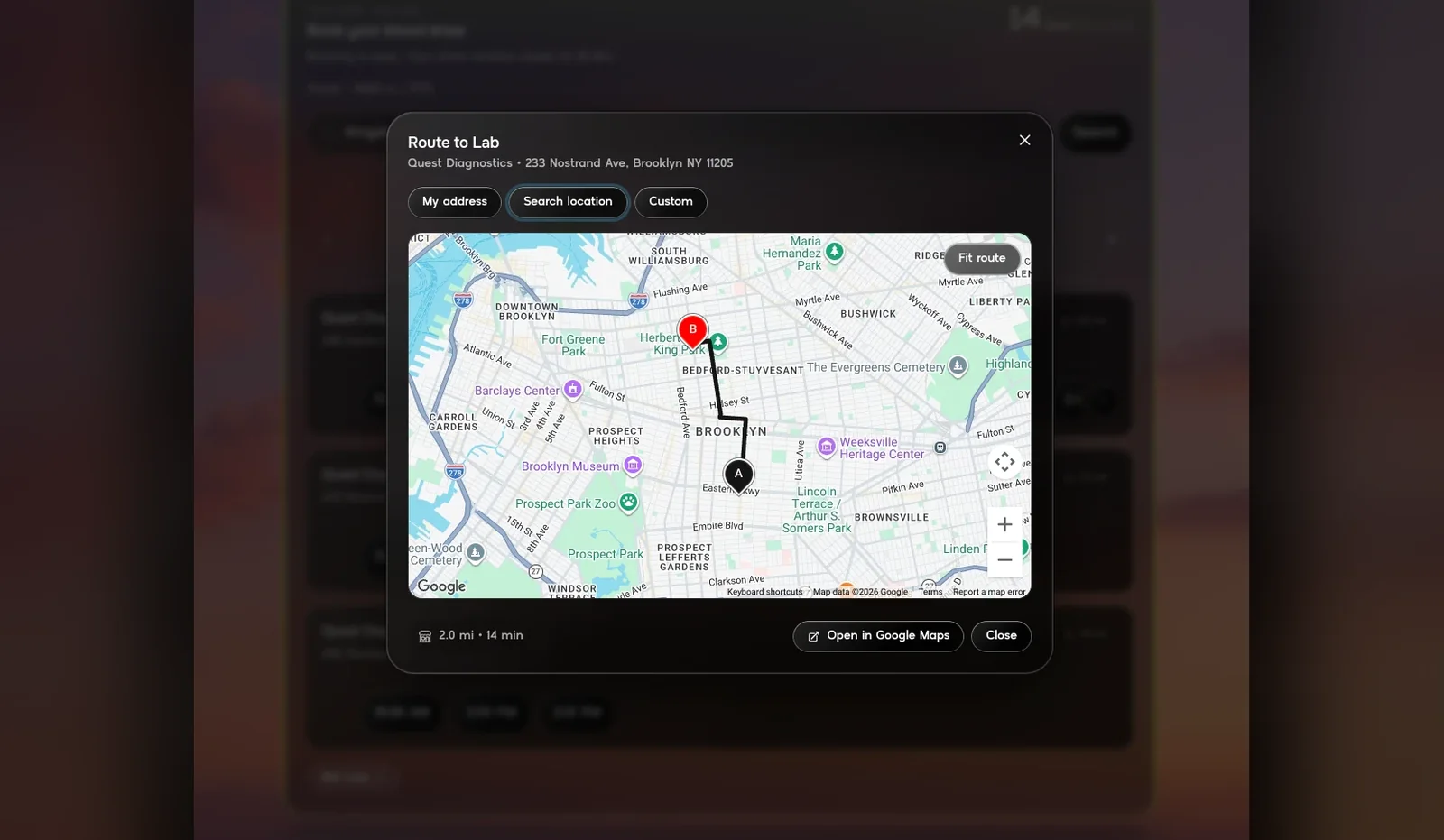
- Booking built in. When a draw is due, the dashboard counts down the days left to book, lists nearby lab locations with open times and maps the route.
Peptides at OneTwenty
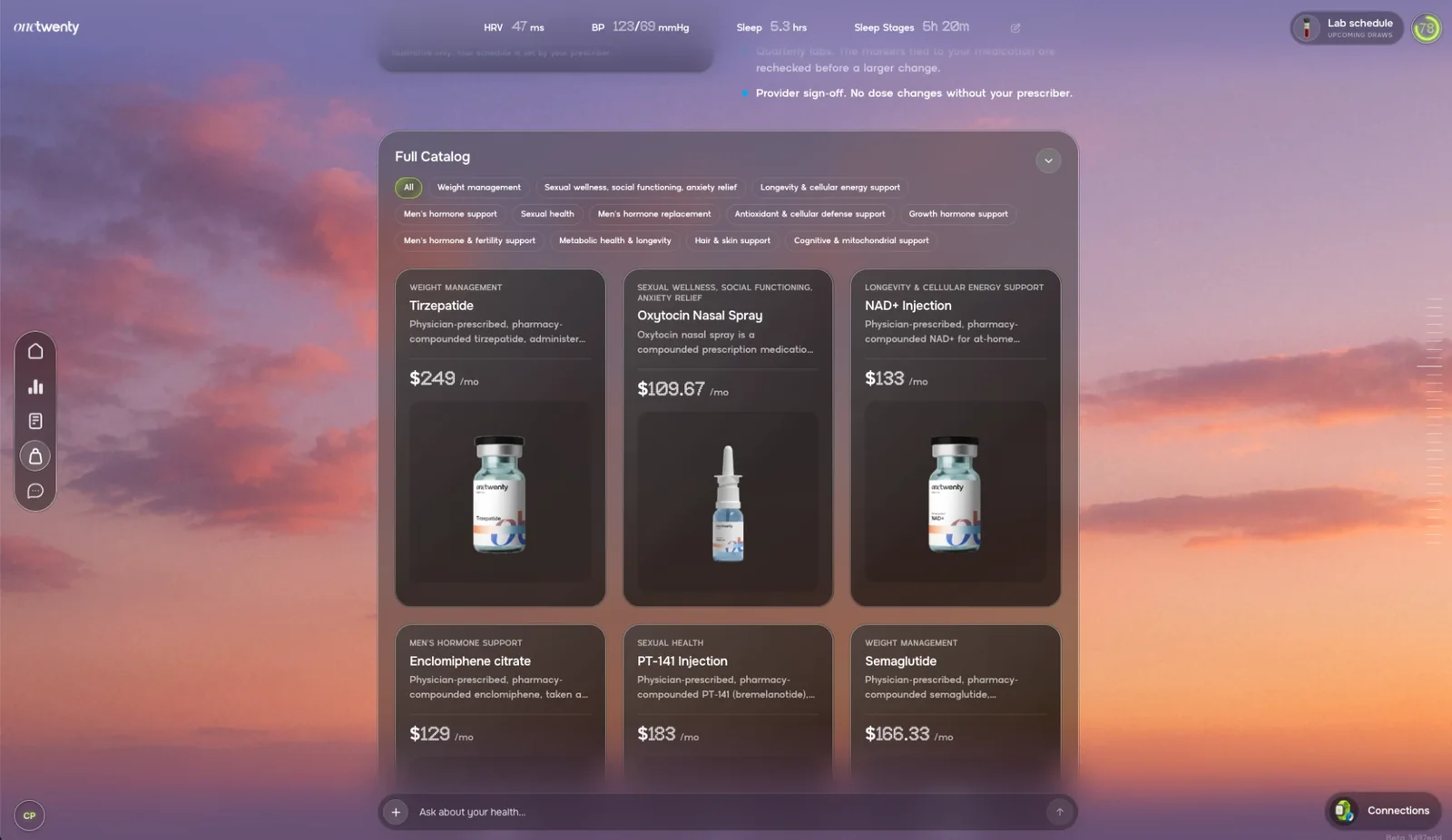
Peptides are short chains of amino acids, the building blocks of proteins, and several are prescribed as treatments. The GLP-1 medications semaglutide and tirzepatide are peptides. OneTwenty’s catalog also carries the ones below, each physician-prescribed and prepared by a licensed U.S. compounding pharmacy, and only after an independent licensed provider has reviewed your labs.
- Sermorelin. A growth hormone releasing hormone analogue that prompts the pituitary to release more of your own growth hormone rather than replacing it. OneTwenty offers it for lean muscle, recovery and sleep.
- PT-141 (bremelanotide). Acts on melanocortin receptors in the brain and is prescribed for low sexual desire and arousal.
- GHK-Cu. A copper peptide in a cream, applied to the skin for appearance and repair.
- Oxytocin nasal spray. A peptide hormone involved in bonding and social connection. Research on it for social anxiety is mixed, so it belongs alongside anxiety treatment, not in place of it.
Every peptide runs on the same loop as the rest of the membership. Your labs set the baseline, your device data fills the gaps between draws, and the markers tied to the medication are rechecked at your quarterly labs before any larger dose change. Nothing changes without your prescriber, and you are not charged until a clinician approves the treatment. Compounded medications are not FDA-approved, which means the FDA does not review them for safety or effectiveness before they reach you, so ask your provider what the evidence shows for anything you start.
See how OneTwenty worksHow to Choose
- Have you had a full panel in the last year? If not, start with breadth. Testing 25 markers monthly makes little sense before you know which ones deserve it.
- Do you know which markers you are tracking? If you can name them and they are on Rythm's list, Rythm is the more useful tool. If you cannot, it is the wrong one.
- Will you actually go to a lab? Be honest. A membership you never book a draw for is worth less than a $100 kit you use.
- How often will you really test? Rythm costs about $100 each time. Decide the number of tests before you subscribe and multiply.
- Do you want advice from a company that sells the fix? Superpower sells supplements and offers prescriptions. Rythm sells neither. Decide which you prefer on purpose.
- Do you live in New York or New Jersey? Get Superpower's real quoted price at checkout. In New York, Rythm's men's panel is two markers shorter.
Frequently Asked Questions
Is Superpower or Rythm Health better?
Neither is better outright because they answer different questions. Superpower is better for a broad first look: 100+ biomarkers from a lab draw, for a flat annual fee of $199 to $349 depending on the offer. Rythm is better for watching a short list closely: 25+ biomarkers from an at-home kit as often as monthly, at $79 a test plus shipping and tax.
How much does Superpower cost in 2026?
It depends on the offer running when you join, because Superpower changes it every couple of months. During 2026 it has sold its membership at $199 a year with one blood draw of 100+ biomarkers, and at $349 a year with two draws covering 150+ biomarkers. Check its site on the day you buy. Pricing may vary in New York and New Jersey.
How much does Rythm Health cost per year?
It depends how often you test. Rythm lists $79 a test plus shipping and tax, and regular orders are reported at about $100 delivered. Tested monthly that is about $1,200 a year. Using the skip option to test quarterly brings it to about $400.
How many biomarkers does each one test?
Superpower tests 100+ biomarkers on its full draw. Rythm tests 25+ per kit, and it is the same panel every time. Rythm's men's and women's panels differ, and two markers on the men's panel, hematocrit and hemoglobin, are not available in New York State.
Is an at-home arm kit as reliable as a lab draw?
Rythm runs its own lab, a licensed physician signs off each report, and published studies show capillary samples from the Tasso+ device track venous draws closely for many routine tests. The practical risk is the collection itself. A sample with too little blood can be rejected, and a sample delayed in transit can come back with markers missing. A lab draw by a phlebotomist does not have that problem.
Can I use Superpower and Rythm together?
Yes, and it is a sensible combination: Superpower for a broad baseline once a year, Rythm for a short panel in between. Superpower plus quarterly Rythm tests comes to about $600 to $750 a year. The drawback is two separate apps and two sets of reference ranges.
Can either one prescribe medication?
Superpower offers access to prescriptions through its platform, with medication billed separately from the membership. Rythm does not diagnose, treat or prescribe.
Are they HSA or FSA eligible?
Both are, and neither is billed to insurance, so you can usually pay with pre-tax dollars.
Is it Rythm or Rhythm Health?
The company spells its name Rythm Health. Many people search for it as Rhythm Health, and they mean the same at-home blood testing service.
Does either one replace my doctor?
No, and both say so. Use the results to have a better-informed conversation with your physician. If you want one service that covers the full baseline and the retests, OneTwenty is the one we point readers to.
Final Verdict: Superpower vs Rythm Health
Both earn 4 out of 5, for almost opposite reasons. Superpower is the best value in broad testing: 100+ markers for $199 to $349 a year, a real lab draw, and an app that does more with the results than most. Rythm is the best at what it set out to do: a test easy enough that you will actually repeat it every month, with results in days.
Each one's weakness is the other one's strength. Superpower shows you everything and then leaves a long gap. Rythm fills the gaps and never shows you everything. So the question to settle before you buy is simple. If you do not yet know what your blood looks like, buy Superpower. If you know exactly which numbers you are trying to move, buy Rythm.
If you want both halves, a full baseline and the retests that tell you whether a change worked, you can pay for the two separately or use one membership that includes them. OneTwenty covers a 101-marker baseline and three targeted follow-ups for $499. That is the option we would look at first.
Want the full panel and the retests in one membership?
OneTwenty includes one full lab panel and three targeted follow-ups a year, daily device data, a health coach on every panel and prescription access through independent licensed providers, with your plan reviewed every 90 days. Available in every state except Rhode Island. $499 a year, $749 in New York and New Jersey.
Get started with OneTwenty