

Try:
Use in session
Therapy games and worksheets
17 interactive games and 6 worksheets for kids, teens, adults, couples and families. Each has a present mode for screen sharing over telehealth and a free printable PDF.
Showing 6 of 23
 FeelingsGame
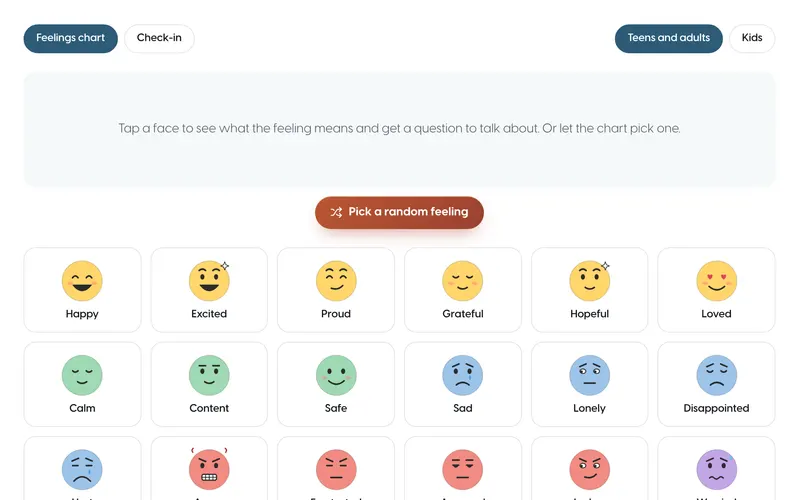
Feelings Chart
Thirty feeling faces, a kids version, a random-feeling game and a guided check-in that ends with a card to keep.
Kids, teens and adults · Printable PDF
Open →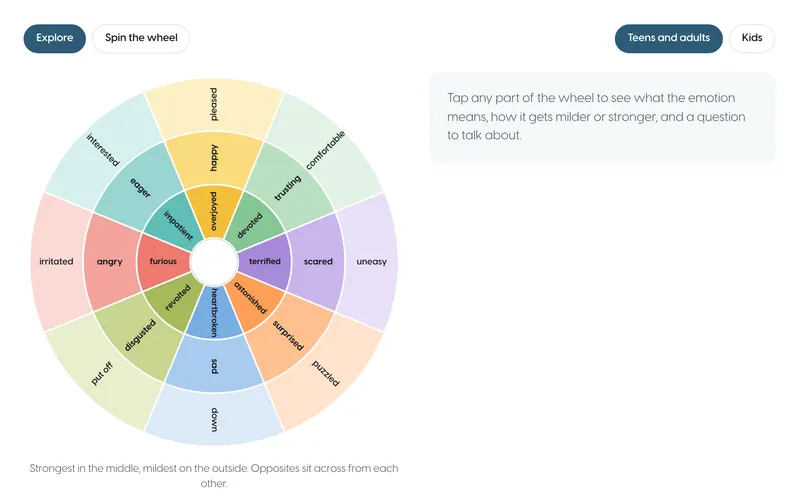 FeelingsGame
Emotion Wheel
Eight core emotions in three strengths, with a spin-the-wheel game and a kids wheel of faces.
Kids, teens and adults · Printable PDF
Open →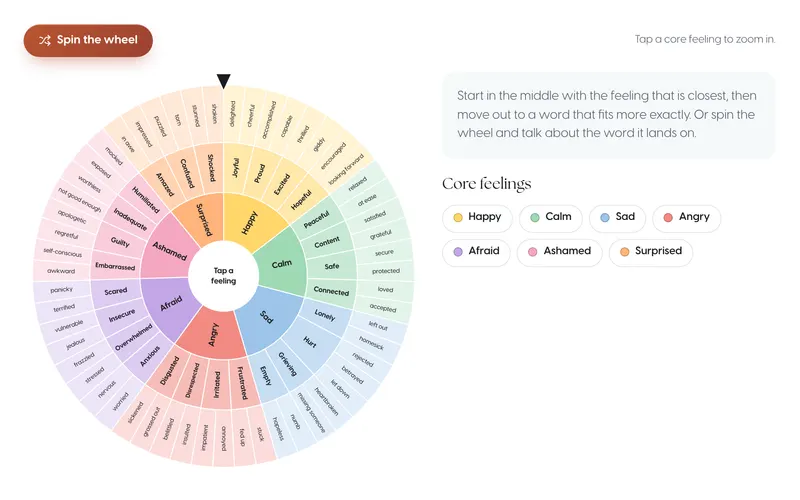 FeelingsGame
Feelings Wheel
Eighty-nine feeling words in three rings. Zoom into a feeling, find the exact word, keep a list, or spin for a question.
Ages 9 to adult · Printable PDF
Open →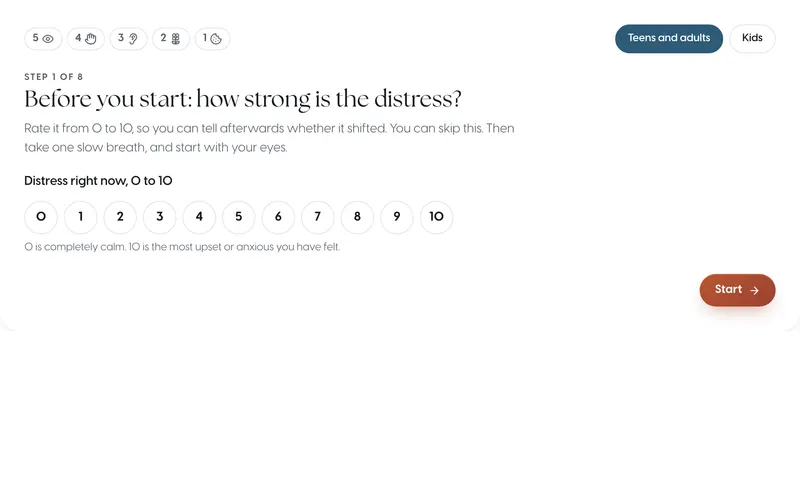 GroundingGame
5-4-3-2-1 Grounding
A guided senses exercise with a kids picture hunt and a 0 to 10 check before and after. Ends with a card to keep.
Kids, teens and adults · Printable PDF
Open →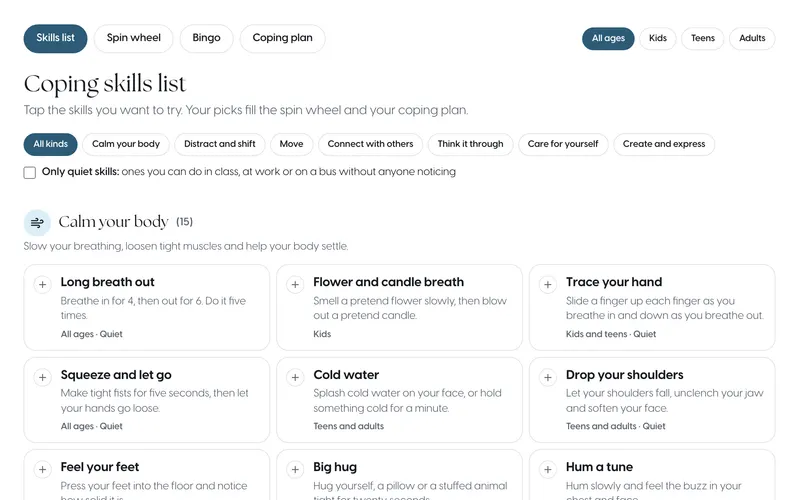 Coping skillsGame
Coping Skills Toolbox
A list of 96 coping skills by age, a spin wheel you fill yourself, bingo cards for groups and a coping plan to print.
Kids, teens and adults · Printable PDF
Open →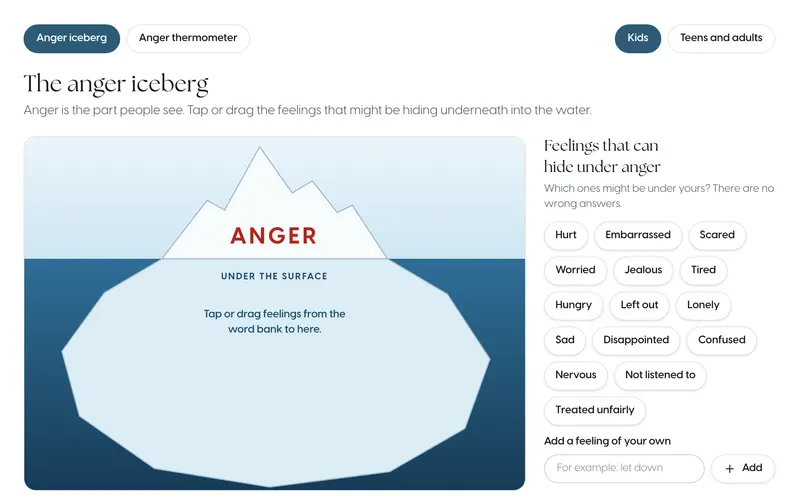 AngerGame
Anger Iceberg
Drag the feelings hiding under anger below the waterline, then rate anger on a thermometer and make an anger plan.
Kids, teens and adults · Printable PDF
Open →


Or browse the therapy games and the therapy worksheets.
Screen and track
Scoring tools
Every screening can be handed to a client on your device, with the score hidden until you take it back, or sent by link with the results emailed to you. Copy a one-line summary for the session note, or print the results.
Depression and mood
Anxiety and stress
Trauma and dissociation
- PCL-5 · PTSD symptoms, by DSM-5 cluster96127
- Trauma Impact · Distress after a specific event96127
- DID Screening · Dissociation96127
Attention and autism
Personality and traits
- Narcissism Test · Narcissistic personality traits
- Sociopathic Traits · Psychopathic traits, self-reported
- PCL-22 · Psychopathic traits, checklist
- Myers-Briggs Style · Personality preferences (informal)
Children and teens
- SCARED (child) · Child anxiety, in the child's words96127
- SCARED (parent) · Child anxiety, in the parent's words96127
96127 marks a standardized instrument commonly billed as CPT 96127. Payers set their own limits.
EMDR
EMDR Studio, with remote control
Moving dot, light bar, tones, music and tapping in one screen. Start a remote session and control your client's screen over telehealth: start, stop, speed and set length. Only the settings travel between screens, and nothing is stored.
- Set counter with an automatic pause and a 0 to 10 check-in
- Two phones as left and right tappers, or a game controller's rumble
- Saved presets per client, and a Stop and ground button the client always has

At a glance
Screen, code, treat
Which screening to reach for, and the codes commonly documented for the same concern. For reference only: a screening score is not a diagnosis, and no code follows from a score on its own.
| Concern | Screen with | Codes often documented | EMDR tools |
|---|---|---|---|
| Depression | PHQ-9, CESD-R | F32.0, F32.1, F32.2, F32.3 | |
| Perinatal and postpartum depression | EPDS, PHQ-9 | F53.0, F32.1, F33.1 | |
| Generalized anxiety and panic | GAD-7, DASS-21 | F41.1, F41.0, F40.10, F40.00 | Yes |
| PTSD and trauma | PCL-5, Trauma Impact | F43.10, F43.11, F43.12, F43.0 | Yes |
| Dissociation | DID Screening | F44.81, F44.0 | Yes |
| OCD and related | OCI-R | F42.2, F42.3, F42.8, F42.9 | |
| Adult ADHD | ASRS | F90.0, F90.1, F90.2, F90.9 | |
| Autism in adults | RAADS-14, AQ-10 | F84.0 | |
| Alcohol use | AUDIT | F10.20 | |
| Drug use | DAST-10 | F12.20, F11.20, F13.20, F14.20 | |
| Personality traits | Narcissism Test, Sociopathic Traits | F60.81, F60.2, F60.3, F60.5 | |
| Child and teen anxiety | SCARED (parent), SCARED (child) | F41.1, F40.10, F41.9 |
Clinical reference
Diagnosis and billing codes
87 DSM-5-TR, ICD-10-CM and CPT codes, each with diagnostic criteria, documentation essentials, differential diagnosis and billing notes.
Billing codes therapists use most
- 90791 · Psychiatric Diagnostic Evaluation
- 90834 · Psychotherapy, 45 Minutes
- 90837 · Psychotherapy, 60 Minutes
- 90832 · Psychotherapy, 30 Minutes
- 90846 · Family Psychotherapy Without Patient Present
- 90847 · Family Psychotherapy With Patient Present
- 90785 · Interactive Complexity
- 96127 · Brief Behavioral Assessment
Browse by category
- Anxiety Disorders · 10
- Depressive Disorders · 12
- Trauma & Stress-Related · 9
- Bipolar Disorders · 7
- OCD & Related · 5
- Neurodevelopmental · 5
- Personality Disorders · 8
- Substance Use Disorders · 6
- Eating Disorders · 5
- Psychotic Disorders · 5
- Sleep-Wake Disorders · 1
- Somatic Disorders · 1
- Dissociative Disorders · 2
- Billing & CPT Codes · 11
For the money conversation
Calculators to share with clients
Join Crown
Like the tools? Work with the team that builds them.
Crown Counseling is a group practice in Brooklyn and online across New York. See what is open now.
Billing and coding notes are general reference, not legal or billing advice. Payer rules vary; check each payer's policy. Looking for therapy yourself? Client resources are here.